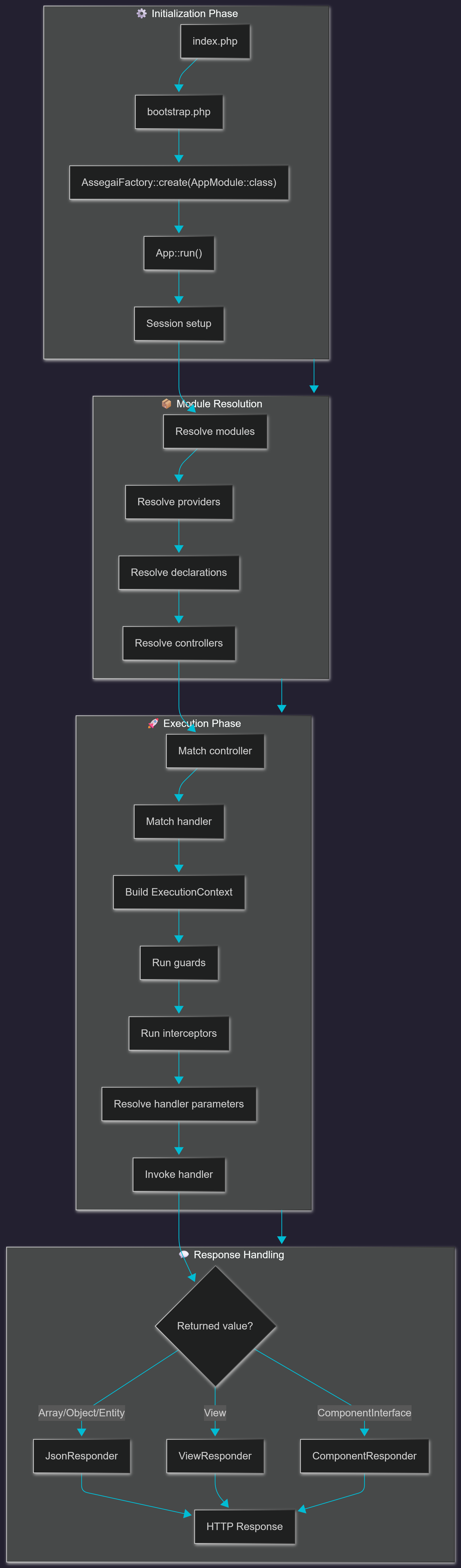
Core, Console, Starter, the supporting framework modules and queue adapters are available through Composer.
Deployments often need application files, secrets and writable state to live in different places. Replacing a release directory should preserve sessions, uploaded files and configuration owned by the deployment.
AssegaiPHP's ApplicationPaths value makes those locations explicit at bootstrap. Existing applications can keep their current factory calls. Applications that need separate locations can opt into the path contract without changing their controllers or providers.
Choose the locations before bootstrap
use Assegai\Core\ApplicationPaths;
use Assegai\Core\AssegaiFactory;
use MyApp\AppModule;

$paths = new ApplicationPaths(
    applicationRoot: '/srv/my-app/releases/current',
    configurationDirectory: '/etc/my-app/config',
    secretsDirectory: '/etc/my-app/secrets',
    stateDirectory: '/var/lib/my-app',
    composerDirectory: '/srv/my-app/dependencies',
    environmentFile: '/etc/my-app/secrets/.env',
);

AssegaiFactory::createFromProject(AppModule::class, paths: $paths)->run();
Provision the directories first, and load an autoloader that maps application classes to the selected release before creating the app. The Composer directory selects metadata; the bootstrap owns loading the autoloader.
local.php and secure.php use the secrets directory. Other configuration fragments use the configuration directory. An explicit state directory selects the default locations for logs, uploads and PHP file sessions. The sourceRoot setting in assegai.json selects a contained source directory for views and adjacent resources.
Set environmentFile: null to use the process environment without dotenv loading. A selected missing environment file fails bootstrap rather than falling back to another directory.
Explicit paths default to read-only configuration persistence. Request-local Config::set() overrides remain available. Filesystem permissions enforce the deployment's complete access policy.
The Application Paths and Deployment guide covers the defaults, validation rules, source resources and lifecycle limits.
One coordinated framework release
Core, Console, Starter and the supporting framework modules move together on the framework's major/minor line. Patch versions can differ. The pre-existing queue adapter and Attributes streams retain their established relationship with the framework.
The coordinated package versions are:
| Packages | Version |
|---|---|
| Core, Console and Starter | 0.11.1 |
| Supporting framework modules | 0.11.0 |
| RabbitMQ and Beanstalkd | 1.2.0; recommended graph uses Common 0.11 |
| Attributes | Existing compatible 1.0.3 |
The queue adapters previously moved from 1.0 with Common 0.9 to 1.1 with Common 0.10. Their 1.2 line carries that relationship forward. Attributes keeps its compatible existing line. Historical releases remain available.
The release plan identifies each module's artifact. Each module's Composer dependency ranges describe the combinations supported by its implementation and tests. Those ranges can retain verified older releases alongside the coordinated target. The installation examples below select the recommended graph for this release.
Console 0.11.1 replaces the incomplete dependency recommendations in Console 0.11.0. Its catalog, project defaults and update plan use the same reviewed release inventory, including the supporting modules and queue adapters. The release inventory records aligned artifacts separately from tested dependency compatibility.
Upgrade an application
Commit or back up the application, then install Console and inspect the migration:
composer global require assegaiphp/console:~0.11.1 --with-all-dependencies
assegai --version
assegai update --to=0.11 --dry-run
Review every proposed dependency change before applying it:
assegai update --to=0.11
composer validate --strict
composer show "assegaiphp/*"
Review direct require and require-dev dependencies. Adding support for the coordinated target must preserve previously verified dependency support, including compatible later patches and broader supported ranges. Review unresolved compatibility conflicts before approving changes.
Queue applications should review their transport and Common together. These examples explicitly select the coordinated target graph. Check existing manifest ranges before applying them so a targeted upgrade preserves support the application still needs:
composer require assegaiphp/common:~0.11.0 assegaiphp/rabbitmq:~1.2.0 --with-all-dependenciescomposer require assegaiphp/common:~0.11.0 assegaiphp/beanstalkd:~1.2.0 --with-all-dependenciesUse the 0.10.x to 0.11.1 upgrade advisor for the application-specific checks. Run the full application suite after upgrading, including authentication, rendering, ORM operations and queue success/failure paths used by the application.
Existing factory calls retain their defaults. Opt into ApplicationPaths only after reviewing the deployment layout. Keep secrets and persistent state outside the public document root and replaceable application directory.
Deployment boundaries
Path selection does not perform worker draining, release switching, rollback or automatic configuration reload. Restart long-lived workers after application code, secrets or configuration change. App::boot() prepares the in-memory graph; it does not prove a deployment is ready to receive traffic.
Documentation and release checks
The documentation selector provides separate 0.11, 0.10 and 0.9 guides. Read the guide matching the installed framework. The archived guides preserve their commands and behavior.
The shared release check validates the complete module inventory and owner evidence. Website's content check verifies its actual guide, article, advisor and archived documentation against the same inventory. Preparation, published package availability and Website deployment are distinct checks.
Package sources and release notes are maintained in the Core, Console, Common, RabbitMQ, Beanstalkd and Attributes repositories.